
HOME / JOURNAL / Professional Ski Photography vs GoPro: What Matters
Professional Ski Photography vs GoPro: What Matters
Professional ski photography vs GoPro on the Arlberg: distance, timing, editing, and same-day previews by 8pm. Why a photographer beats a chest mount

Arlberg Collective
Ski photography · St. Anton am Arlberg
Ski Photography: Professional vs. GoPro — The Real Differences That Matter
A GoPro shows what you saw. A photographer shows what it felt like. That single gap explains most of the frustration people feel when they get home from a ski trip, open the footage, and realise the best day of the week looks flat on a screen. If you are weighing professional ski photography vs GoPro for your trip to St. Anton, the honest answer is that they do two different jobs. One is a camera strapped to your chest. The other is a person who skis the Arlberg every day and knows where to stand. Here is what each actually delivers, where the GoPro falls short, and when you need the real thing.
What a GoPro Does Well (and What It Doesn't)
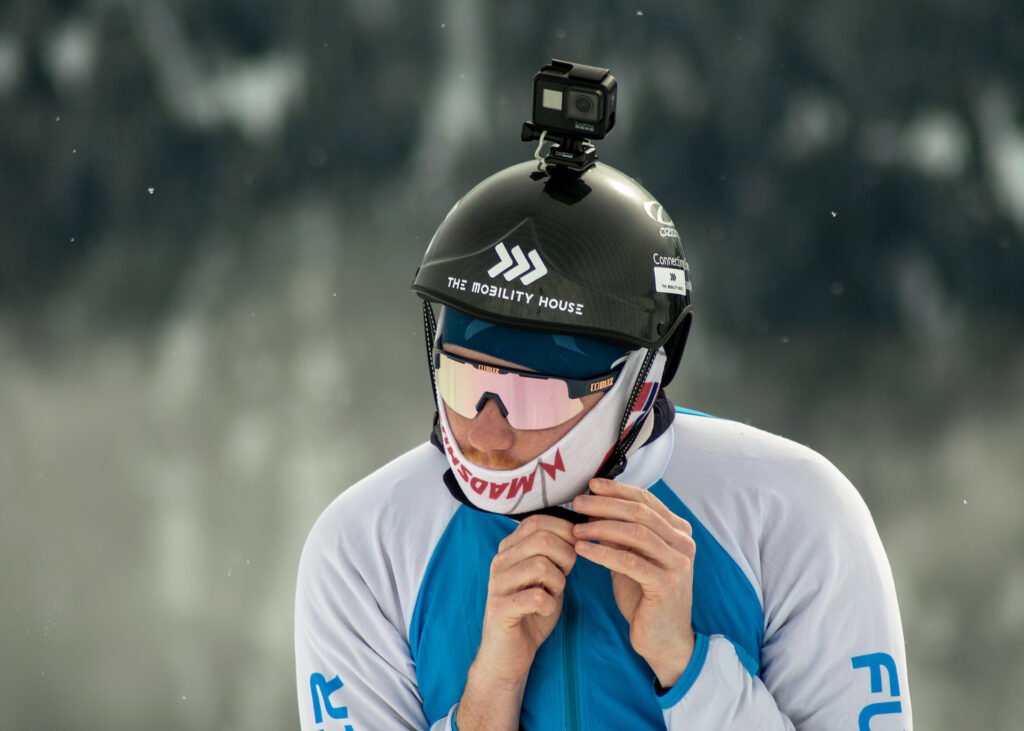
A GoPro is a brilliant piece of kit for what it was built to do. It is small, tough, waterproof, and it runs while you ski without you thinking about it. For a first-person record of speed, a steep entry, or the moment you drop into a chute, nothing else is as convenient. If you want to feel the run again from your own eyeline, the chest mount or helmet mount earns its place.
The limits show up the moment you want a photograph rather than a memory of motion. A GoPro sees everything from one fixed point — wherever it is bolted to your body. The ultra-wide lens stretches the mountain, shrinks the terrain, and pushes the horizon into a curve. You are never in your own footage, because the camera is on you. The Valluga behind you becomes a small grey smear. And the files pile up fast: an hour of skiing is hundreds of gigabytes of shaky clips you will never sort through. Most people film three days, watch none of it, and forget the card exists by April.
Professional Ski Photography vs GoPro: Distance, Composition, and Timing
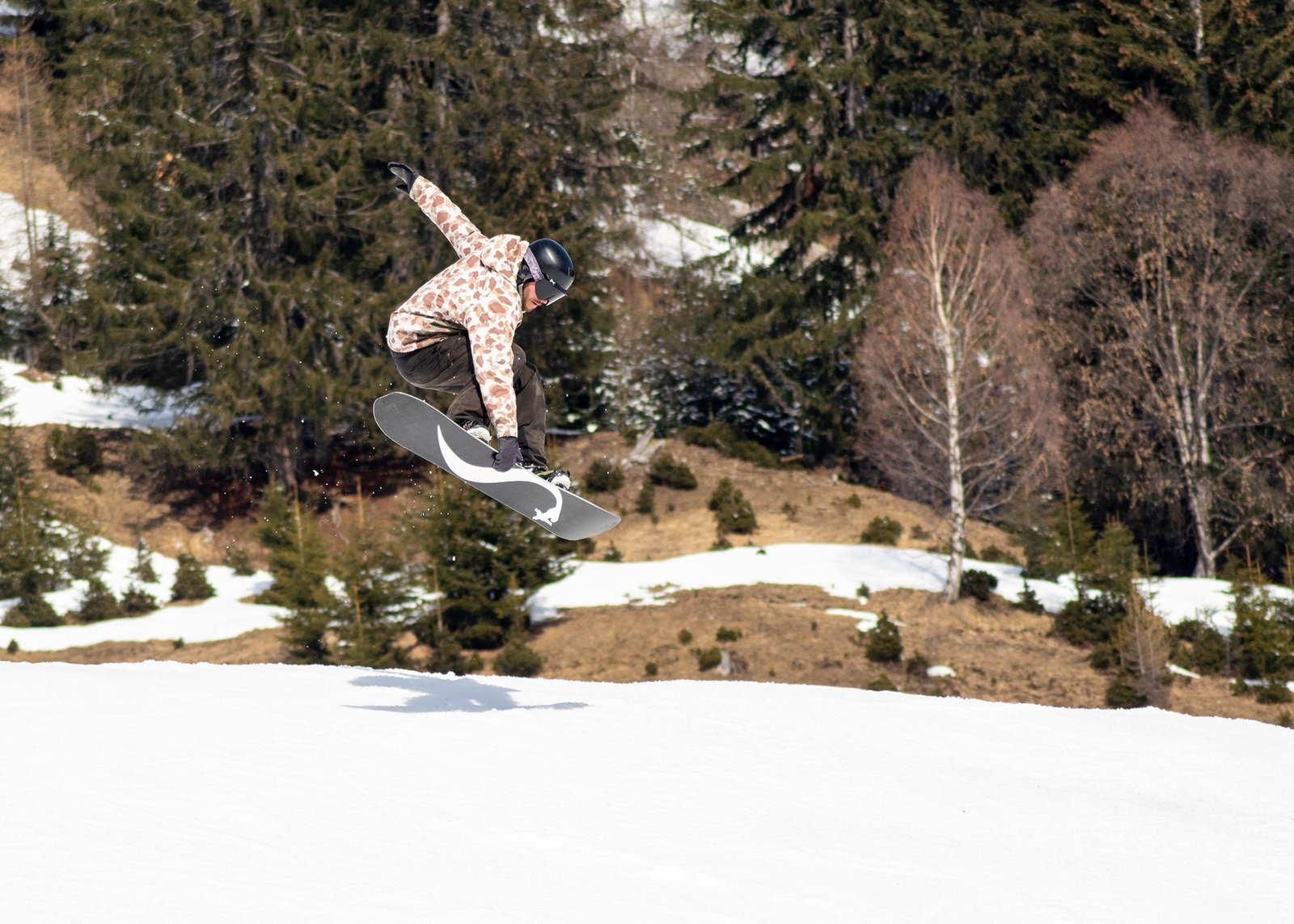
This is where the two part ways completely. A photographer is not attached to you, so the whole mountain becomes a frame. We ski ahead, drop below a roller, climb a ridge, or hold a line off to the side — whatever puts the Arlberg behind you instead of a fisheye blur. Distance is a choice we make shot by shot. Close enough to read the spray off your edges, far enough to show the scale of the terrain you are actually skiing.
This is where the two part ways completely. A photographer is not attached to you, so the Composition is the part a body-mounted camera cannot do at all. We place you against the light, against the ridgeline, against the empty white of a powder field. We wait for the gap in the trees, the clean section of piste, the moment the slope opens up behind you. The [Arlberg’s terrain](https://www.skiarlberg.at) — St. Anton, Rendl, Kapall, the runs over to Lech and Zürs — gives a photographer who knows it endless backdrops, but only if someone is positioned to use them. Mountain becomes a frame. We ski ahead, drop below a roller, climb a ridge, or hold a line off to the side — whatever puts the Arlberg behind you instead of a fisheye blur. Distance is a choice we make shot by shot. Close enough to read the spray off your edges, far enough to show the scale of the terrain you are actually skiing.
Then there is timing. A skier carving a turn hits one frame where the body, the edge, and the spray all line up. A GoPro running at 30 frames a second technically records it, buried somewhere in the clip. A photographer is watching for it, shooting a burst at 1/2000 of a second, and knows it is coming because we have watched ten thousand turns before yours. The difference between a good ski image and a forgettable one is often a tenth of a second. That is a decision, not luck, and a camera on your chest cannot make it.
Editing and Delivery
A raw frame off any camera, GoPro included, is not the finished image. Snow confuses automatic exposure, flat light kills contrast, and the brightness of a glacier against a dark treeline is more range than a sensor handles cleanly on its own. The work that makes a ski photograph look like the day felt happens afterwards, in the edit.
That is the half of the job nobody sees. We pull detail back into the highlights, lift the shadows, correct the blue cast that snow throws across everything, and grade each image so the white reads as white and the sky as the sky. A GoPro hands you the footage and walks away. You are left to do the editing, which means you never do it.
Delivery is where we close the gap entirely. You ski with us, and the best images land on your phone the same evening — five frames from a Half Day, eight from a Full Day, previewed by 8pm while you are still out. The full edited gallery follows within five working days through a private Pixieset link, yours to download and keep with a personal-use licence included. No card to wade through. No project waiting for a rainy afternoon that never comes.
The Reality: Why a GoPro Can't Replace Professional Ski Photography
Stacked side by side, professional ski photography vs GoPro is not a contest of camera quality — it is a contest of what the two things are for. A GoPro is a sensor that goes where your body goes. A photographer is judgement: terrain reading, positioning, timing, light, and an edit, all aimed at producing images you will actually use.
Think about the maths of a ski holiday. A family or a group of friends spends well into the thousands on flights, accommodation, lift passes, and gear. The photography is the one part you keep after the snow melts, and the GoPro version of it is the part that quietly disappears into a drive nobody opens. A Half Day with us is €550 per session for up to four people. A Full Day is €890 per session, again for up to four. Both prices are per session, not per person — four of you pay one fee. For groups of five to eight, a second photographer is added (+€240 on a Half Day, +€360 on a Full Day) so everyone is in the frame, not just whoever remembered to film. You can see the full structure on our [on-piste ski photography page](/services/on-piste-photography/).
A GoPro is a few hundred euros, runs all week, and gives you the eyeline. Keep it for that. But it will not put you in the picture, hold the Valluga behind your shoulder, find the one frame where the turn is perfect, or hand you finished images before dinner.
When You Need the Real Thing
Some days a GoPro is genuinely all you want, and that is fine. A relaxed afternoon of cruising, a personal record of a steep line, the first-person rush — strap it on and enjoy it.
Book a photographer for the days that matter. The family trip you took once because the kids were finally old enough. The friends’ reunion that took three years to organise. The first proper powder morning of the season. The week in St. Anton you saved for. Those are the days worth more than footage on a card, and they are exactly the days a chest mount lets slip through.
So the choice in professional ski photography vs GoPro is not really either-or. Run the GoPro for the eyeline. Book us for the images you will still be looking at in ten years — shot from the right distance, in the right light, at the right moment, edited properly, and on your phone by 8pm.
Pick your days, then [book your session at Arlberg Collective](/experiences/). You ski. We shoot. Images before dinner.
// READY TO SHOOT?
Get your session in the diary.
Pick your package and dates and we’ll plan the route around the best light of your trip.